For Principals: Leading Attendance Through Engagement
Step 3: Cultivate a school-wide, yearlong approach to engagement
Principals play a critical role in creating welcoming, engaging school environments that emphasize relationship building and two-way communication and that ensure students and families feel seen, supported and connected at school. The good news is that schools can take action on their own by introducing practices that create a welcoming environment to support student achievement and well-being.
A welcoming and engaging school climate occurs when schools:
- Mobilize everyone. Set the expectation that all staff play a critical role in reducing chronic absence and increasing student engagement.
- Establish a school-wide culture of student connectedness, engagement and attendance that fosters positive conditions for learning.
- Take a yearlong approach. Promote showing up to school throughout the year through proactive outreach and strong relationship building. Use data to anticipate and address attendance dips.
When everyone is involved, on-time attendance becomes a highly visible, high-priority community value that supports educational success for all. The entire school community can contribute to a welcoming, engaging school environment that emphasizes:
- Building and nurturing relationships with students and families
- Partnering with students and families to promote the importance and value of attending every day
Set expectations that all staff play a critical role in reducing chronic absence. All staff are integral in promoting positive outreach because they are in regular contact with students. Too often, student engagement and attendance are seen as the responsibility of social workers and student support staff and as a result, are siloed or misaligned with existing academic and behavioral improvement strategies.
Partner with district administrators, public agencies and community partners who can collectively support outreach to make attendance a priority throughout the year. These partners can also help develop and implement activities and interventions at scale.
Watch this video from the Rollins Center for Language and Literacy at the Atlanta Speech School showing how educators provide a warm and welcoming climate for students.
A pathway to mobilize everyone. There are several strategies a principal and school team can use to get everyone on board.
Talk about attendance. Make it a priority to raise awareness of the impact chronic absence has on students’ overall development and how missing school can hinder academic progress.
- At staff meetings, include attendance as a standing agenda item. Share a brief update on school-wide or grade-level attendance data or highlight an effective Tier 1 or Tier 2 strategy or intervention your school is using.
- Encourage staff to review attendance data and integrate it with academic and behavior metrics during grade-level or content-level staff meetings.
- Share attendance and chronic absence data with the broader school community, including families.
- Use existing events to promote attendance, such as parent-teacher conferences or orientation meetings for school sports.
- Foster a school-wide culture that celebrates attendance improvements and builds trust with families. Download Making the Most of Your Parent-Teacher Conference.
- Help staff understand how absences — even when excused — can add up and hinder academic progress.
- Use data to highlight when absences affect student learning, beginning as early as preschool and kindergarten, and continue reviewing data throughout the school year.
- Participate in the Attendance Awareness Campaign. Join districts, schools, communities and organizations throughout the country that are using the Attendance Awareness Campaign to launch the school year to build awareness of the importance of attendance.
Communicate about attendance with families. Help families understand what their children are learning in school and what they will miss if they are absent. Parents and students may not realize that even excused absences, if they accumulate, can lead to falling behind in the classroom. Few families realize that absenteeism can be a concern as early as preschool and kindergarten.
Establish two-way communication with families and be sure to affirm families as partners:
- Use a school app that supports two-way communication to share something positive the student has done. The student’s teacher, homeroom or advisory teacher, or a paraprofessional can correspond with families.
- Communicate directly with students after an absence. Let students know they were missed and what they missed while they weren’t in school.
- Integrate attendance-related information into curriculum nights, newsletters and parent- or student-led conferences.
- Communicate clearly and often with families about health-related absences, including guidance on when to send a child to school after an illness or how to help a student who may have anxiety. Share health-related handouts with families.
Sample letters to send home:
Share handouts for families with tips on getting students to school regularly and on time for different age groups.
Attendance indicates that students (and their families) are motivated to show up to school and have the opportunity to be engaged by the learning activities taking place. Principals can use a range of strategies to establish and maintain a positive, safe and supportive culture throughout the school.
Student connectedness is an effective, whole-school prevention strategy that does not require extensive training and easily builds on activities that are already underway. Students feel connected to schools when they:
- Believe there is an adult at school who knows and cares about them
- Have a supportive peer group
- Engage, at least some of the time, in activities they find meaningful and that help others
- Feel seen, heard and welcome in school
Create opportunities for students, families and staff to experience a sense of belonging. Build staff capacity to create a consistent school-wide approach by ensuring that all staff have a variety of relationship-building structures and strategies that can impact how the school operates in the classroom and throughout the building.
Develop systems and strategies that promote positive conditions for learning. Four conditions for learning can affect attendance: physical and emotional health and safety; belonging, connectedness and support; academic challenge and engagement; and adult and student social and emotional competence. Relationships are at the center of each of the four conditions.
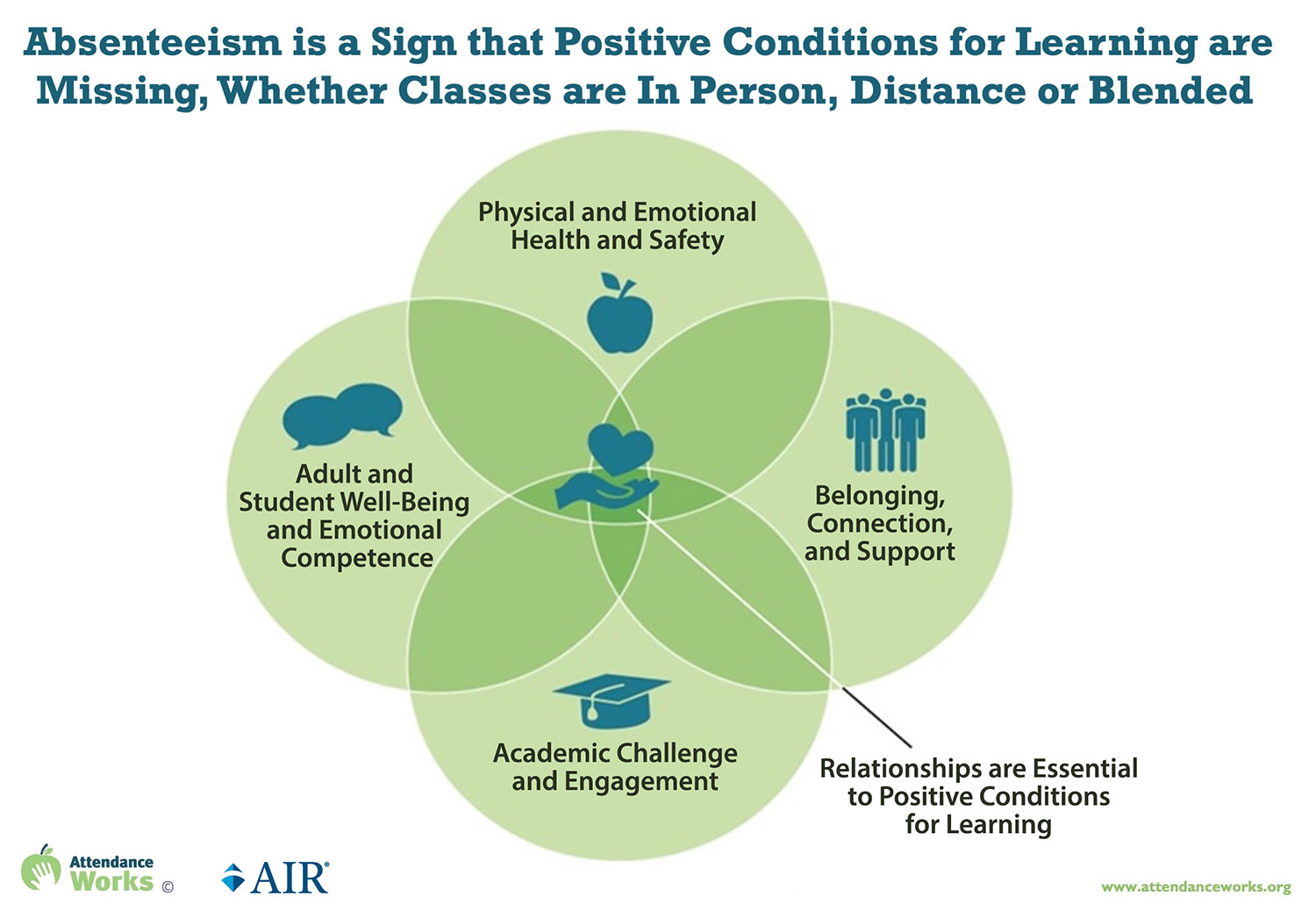
Strategies that support positive conditions for learning include:
- Positive greetings throughout the day. Staff should be expected to greet students and families positively at the school entrance in the morning and throughout the day. Acknowledging students by their names and/or interests can go a long way toward building a connection. If students arrive late, let them know you are glad to see them and hope to see them earlier the next day.
- Morning meetings or advisory groups. Reserve time each week to check in with the class through structured or informal discussions. These meetings help students build meaningful relationships with their peers and their teacher or homeroom teacher, allow time to reflect on and monitor academic progress, and create a place where students feel they belong and can succeed.
- Interactive hands-on project-based learning. Promote inquiry-based lessons designed to be meaningful, engaging and relevant to student’s identities, cultures and experiences. Use strategies that encourage students’ active involvement.
- Relationship mapping. Identify which students have a positive connection to an adult in the school, either considering all students or focusing just on students who are Tier 2. Harvard’s Relationship Mapping resources can be used to ensure that every student has a meaningful connection to an adult in the school community.
- Elevating students’ voices. Student perspectives matter. Students’ voices should reflect the demographics of your school. Students can offer important insights into challenges to regular attendance as well as what can create a more positive climate. When changes are made based on student feedback, let them know their input is appreciated.
Activities such as adult and peer mentoring, service-learning opportunities, student-led clubs and efforts to amplify student voices during the school day, after school or in summer learning programs can also promote connectedness.
Building positive connections with families promotes shared values and expectations around attendance and learning and reinforces the message that every day in school matters.
Involving families in the school community includes asking families to attend events and listen to staff feedback on learning goals. To engage families further, schools can ask them to volunteer and when appropriate, solicit their feedback on volunteer projects. Intentionally partnering with families, such as encouraging them to serve on committees with decision-making capacity or to co-lead volunteer opportunities, can help build trusting relationships.
Here are some strategies for improving family engagement:
- Hold monthly or quarterly family sessions with the principal. These meetings can take place during the day when families drop off their students or in the evening with the option of meeting virtually. Providing food and childcare at early-evening events is always helpful. The topics should be based on what parents request and could range from understanding the math program to addressing student anxiety.
- Form a family advisory committee. The group can meet several times a year to discuss issues affecting the school and solicit feedback from families. Membership on the committee should reflect the student body.
- Maintain positive communications with families. Whether their children attend elementary or secondary school, families benefit from hearing positive messages about their students from the school at least once or twice a year.
Keeping students engaged, learning and showing up to school is an endeavor that should continue beyond the first few months of the school year. Engage your team in crafting and implementing a yearlong plan for supporting attendance. Identify who is responsible for leading each activity and the resources and support needed to implement each strategy. These resources can help you develop a yearlong plan:
- Attendance Works Year-Long Planning Calendars are tools for planning activities and events that keep the focus on improving attendance all year long.
- The Attendance Playbook from FutureEd and Attendance Works describes interventions using a multi-tiered system, summarizes supporting research and highlights schools and school districts that have used the strategies successfully.
- The Guide to Using the Attendance Playbook helps educators and their teams with thinking through key questions for selecting, prioritizing and implementing strategies.
Bright spot
Kansas City, Kansas Public Schools
Naomi Tolentino Miranda, coordinator of Attend to Achieve for Kansas City Kansas Public Schools, said the district has shifted from a punitive approach to missing school toward a focus on prevention and relationship-based strategies. For example, every school is required to create an attendance plan that includes morning meetings, relationship-building activities and supplemental strategies informed by school-level data. Since implementing these approaches, the district’s chronic absence rate has dropped from 50% to 34.5% — an improvement that exceeds prepandemic levels. Zaneta Boles, principal of Silver City Elementary School, introduced her school’s “champion strategy,” which ensures that every student is known and supported by a caring adult. All staff — including teachers, paraprofessionals and custodians — are assigned a list of students to check in with regularly. One story highlighted this approach: A preschool student received a positive note from his champion and loved it so much that he posted it on his front door for everyone to see. After implementing these practices over two years, Silver City Elementary reduced its chronic absence rate from 54.9% to 38.3%.
Resources
- A video from the Rollins Center for Language and Literacy at the Atlanta Speech School showing how educators provide a warm and welcoming climate for students
- Back-to-school letters for families
- School winter holiday messaging
- Winter weather messaging
- Handouts for families with tips for getting students to school regularly and on time aimed at different age groups
- Health-related handouts for families
- Harvard’s Relationship Mapping Resources
- Attendance Works Year-Long Planning Calendars
- Attendance Playbook
- Guide to Using the Attendance Playbook